FMCG supply chains: why targeted action matters now
11 May 2026
For many FMCG (Fast Moving Consumer Goods) businesses, supply chain pressure
is a key board-level question of cash, margin, availability and customer trust.
The sector is being hit from several directions at once. Energy costs remain volatile. Freight routes are exposed to geopolitical disruption. Packaging, commodities and transport costs are rising. Retailers and consumers remain price-sensitive. Regulations keep moving. And many internal supply chain teams are already operating close to full stretch.
FMCG is a high-volume, low-margin industry. Small changes in cost, lead time, availability or service performance quickly become material.
Geopolitical factors are relevant in an open trading economy. Trade brings access to sales, inputs, choice and productivity, but also exposes companies to global supply chain shocks, concentrated supply routes and regulatory complexity.
The current Middle East disruption is a practical example. It affects oil and gas markets, freight availability, transit times, fertiliser, packaging inputs and export routes. For FMCG businesses, that can mean higher manufacturing costs, longer replenishment cycles, less predictable availability and more working capital tied up in the wrong places.
Many businesses know there is a problem, but still delay action
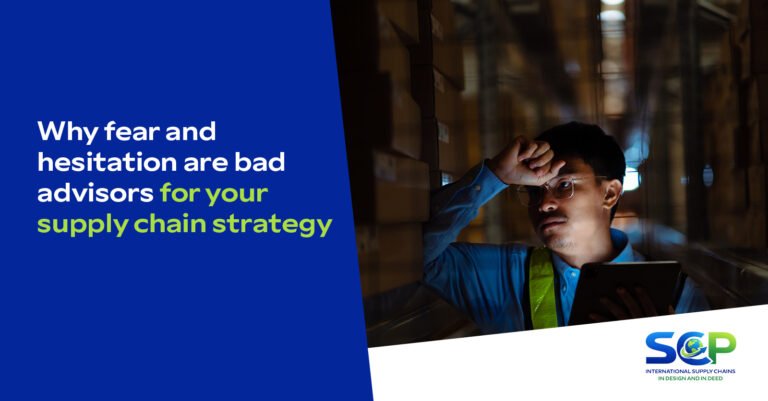
Budget holders are cautious, and a fear factor has become more prevalent, with a focus on job preservation amid a challenging economy. This often results in hiring cheaper, safer, less experienced options.
SCP’s recent market experience points to this pattern: experienced supply chain expertise is recognised as valuable, but companies still often choose the lower-cost option, e.g. hiring more junior and lower-skilled candidates or avoiding spending altogether.
At the same time, supply chain leaders are already operating at very high personal capacity, with little headroom to think beyond immediate operational pressure.
This creates a dangerous gap.
The people closest to the problem can see the operational risk. The people holding the budget can see the cash constraint. Between the two sits hesitation.
And hesitation has a cost.
It shows up in premium freight. Stock-outs. Excess inventory. Missed service levels. Poor supplier decisions. Customs errors. Lost sales. Firefighting. Burned-out teams.
SCP’s point of view: this is not the time for theoretical supply chain advice
FMCG businesses need a clear diagnosis, practical intervention and experienced execution.
SCP was built around that principle: supporting end-to-end international supply chains through strategy, execution and delivery. The business brings together experienced international supply chain practitioners and partners, with a practical, cost-effective approach based on lived operational experience.
The key point is flexibility.
Not every FMCG company needs a large consulting programme. Some need a targeted review. Some need interim leadership. Some need a procurement reset. Some require intervention with freight, customs, or warehousing. Others need help turning fragmented supply chain activity into an integrated S&OP or IBP process.
SCP’s model provides advisory, strategic, execution, and implementation support, including fractional, part-time, or full-time services over agreed-upon periods, with clear stage gates and deliverables.
That matters in the current market because FMCG leaders need confidence that investments will translate into operational and financial outcomes.
SCP’s recommendations
1. Build a clear exposure map
Which materials, suppliers, routes, markets, customers and products are most exposed to geopolitical disruption, energy volatility, customs complexity or freight instability?
Many companies think they know this. Fewer have it mapped clearly enough to support fast decisions.
The output should be simple: where we are exposed, the commercial impact, the options, and who owns the decision.
2. Treat customs and trade compliance as a value lever
Customs, indirect tax and trade compliance are often treated as administrative topics.
That is a mistake.
For FMCG companies trading internationally, errors in commodity codes, origin, valuation, Incoterms, sanctions screening, or duty relief can create avoidable costs, delays, and risks.
SCP’s customs and trade compliance services include customs policy and process reviews, risk and compliance reviews, customs relief optimisation, sanctions reviews, clearance documentation, strategy design and duty reclaims.
In a volatile market, compliance is not just about avoiding problems.
Done properly, it can protect margin and improve cash flow.
3. Reconnect supply chain decisions to cash
In FMCG, inventory is both protection and risk.
Too little stock creates service failure. Too much stock traps working capital. The answer is not simply to cut inventory or increase inventory. The answer is to understand where stock is strategic, where it is accidental, and where planning assumptions are no longer valid.
SCP’s SIOP, S&OP, demand planning, supply planning, and inventory optimisation capabilities are directly relevant here, including forecast accuracy, capacity planning, safety stock, and working capital enhancement.
The question for leadership is blunt:
Are we holding the right stock, in the right place, for the right reason?
4. Decide what should stay in-house and what should be outsourced
Warehousing site and distribution decisions are becoming more important for FMCG firms.
Rising costs, labour constraints, service pressure and changing customer expectations mean the old operating model may no longer be the right one.
SCP supports existing warehousing site reviews, future warehousing site proposals, in-house versus outsourcing assessments, strategic recommendations, operational execution, transformation leadership and PMO.
For some businesses, outsourcing to a 3PL may release cash and improve flexibility. For others, keeping control may be strategically important. The point is to make the decision consciously, not by habit.
5. Review supplier and contract exposure
Procurement cannot be judged only by price.
In the current environment, contract terms, supplier resilience, route dependency, payment terms, lead-time assumptions and escalation clauses all matter.
FMCG companies should review key supplier agreements, procurement processes, tender approaches, and supplier vetting. SCP’s sourcing and procurement support includes supplier reviews, contract reviews, procurement strategy reviews, tender management and new supplier vetting.
The objective is not simply to save money.
It is to avoid buying cheap and paying expensive later.
- Reassess freight, routing and distribution
6. Geopolitical disruption has made routing decisions more strategic.
For FMCG businesses importing ingredients, packaging, finished goods, or components, transport mode, forwarder selection, route-to-market design, and intermodal options can materially affect costs and service.
SCP supports supplier and pricing reviews, network design from the factory floor to the destination, routes to market, mode analysis, and short-sea, road, rail, and intermodal recommendations.
This is especially important where businesses have inherited logistics networks that worked in a more stable world but are no longer resilient enough.
7. Treat customs and trade compliance as a value lever
Customs, indirect tax and trade compliance are often treated as administrative topics.
That is a mistake.
For FMCG companies trading internationally, errors in commodity codes, origin, valuation, Incoterms, sanctions screening, or duty relief can create avoidable costs, delays, and risks.
SCP’s customs and trade compliance services include customs policy and process reviews, risk and compliance reviews, customs relief optimisation, sanctions reviews, clearance documentation, strategy design and duty reclaims.
In a volatile market, compliance is not just about avoiding problems.
Done properly, it can protect margin and improve cash flow.
8. Improve visibility without turning it into a technology vanity project
Technology can help, but only if it serves the operating model.
Many FMCG companies already have ERP, WMS, TMS or planning tools. The issue is often not that no system exists. It is that the data, process and decision rhythm are not joined up.
SCP’s supply chain technology support includes software reviews, market reviews, ERP programme leadership, ERP PMO, and project management for S&OP software, WMS, TMS, and ERP solutions relevant to client size.
The practical question is:
Can leadership see the risk early enough to act before cost, service or cash is damaged?
The leadership decision
The instinct to protect cash is understandable.
But in FMCG, not every cost reduction protects the business.
Some reductions simply shift the cost elsewhere: into service failures, emergency freight, excess inventory, supplier risk, customs exposure, lost sales, or management overload.
The companies that come through this period stronger will not be the ones that spend carelessly. They will be the ones that invest selectively in experience, clarity and execution.
That is SCP’s position.
Supply chain resilience is not an abstract concept. It is a practical operating discipline.
It protects cash.
It protects the margin.
It protects customers.
And in today’s FMCG market, it may be one of the clearest differences between businesses that merely survive disruption and those that use it to build a stronger operating model.